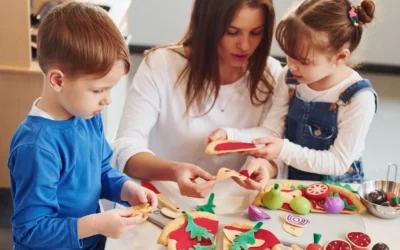
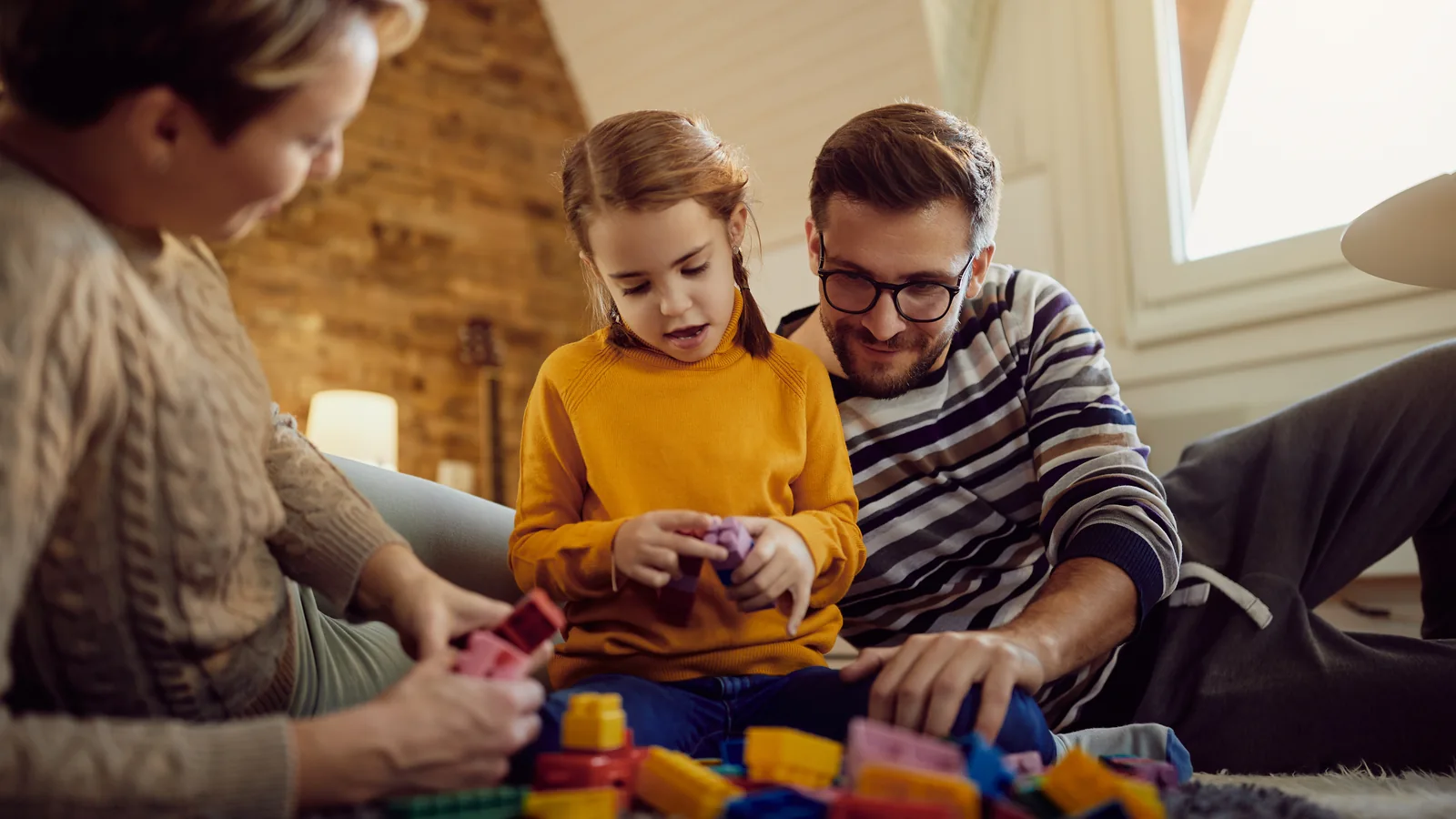
When your child changes a tower that keeps falling or finds another way to sort their socks, they are working something out. They make a choice, see what happens and try again.
Active learning gives children opportunities to build understanding through exploring, making decisions and interacting with others. Your role is to give them room to try and help when they need it. A few familiar materials and something that catches their interest can be a good place to start.
What is active learning?
Active learning means learning through exploration, play and interaction with others. Turning a puzzle piece to see where it fits is a simple example: your child tests an idea and learns from the result.
HighScope’s approach brings together five ingredients: materials to explore, opportunities to handle and change them, choices, communication, and adult support. The choices might be small, such as which piece to try next. A gesture, a few words or showing you what happened can all be ways to share a discovery.
At home, look for the part your child gets to decide. If you place every puzzle piece for them, there is less for them to work out. If you help turn a tricky piece and let them try placing it, they still have a part in solving the puzzle.
Try it: pause before offering a solution. Watch what your child tries, then offer help if they need it.
Does active learning always mean moving?
“Active” includes thinking. Your child may be sitting quite still while wondering what happens next in a story or watching a caterpillar cross a leaf. Running, climbing and dancing can involve learning too, but movement alone does not tell you what a child is thinking about.
This describes a way of learning, rather than a fixed type of learner. Give your child different ways to take part: watching, touching, speaking, pointing, moving or using their usual communication tools.
How do adults help?
You can join in without deciding every step. In guided play, an adult offers materials, a comment or a question that helps a child explore an idea while the child still makes meaningful choices. NAEYC describes guided play as part of a balance between children’s own play and direct teaching.
Sometimes the useful thing is to explain or demonstrate: how to use a tool safely, for example. At other times, your child needs a little space to try. Both kinds of help belong in everyday play.
What are the benefits of active learning?
One game can give your child several things to practice at once. Building together might involve explaining an idea, finding a piece that fits and taking turns. The benefits below are opportunities to look for during play; children develop at different paces, and a single activity does not promise a particular result.
Language and communication
A shared game gives words a purpose. Your child might ask for a bigger piece, tell you where a toy should go or point to show you something surprising. Respond, then leave room for their next word or gesture. These back-and-forth exchanges support early language and social skills, as Harvard’s explanation of “serve and return” describes. The conversation can grow from whatever has caught your child’s attention.
Problem-solving and early concepts
Will this box hold the toy? Which lid fits this container? Play gives your child small problems with results they can see. Comparing and testing introduces ideas such as bigger, smaller, inside and outside. You may notice them turn an object, choose a different one or change their plan before they can explain why. Those attempts give you something useful to talk about together.
Attention, memory and flexible thinking
Copying a short rhythm involves remembering a sequence. Sorting objects by color, then trying size instead, involves changing the rule. Both give your child a chance to practice paying attention and adjusting what they do. Harvard’s play resources include games for attention, working memory and self-control at different ages. Start with a pattern or rule your child can manage, then follow their interest in making it harder.
Creativity and making choices
With blank paper and a few crayons, your child can decide what to make, change direction or enjoy the marks themselves. A line might become a road today and something completely different tomorrow. NAEYC’s guidance on creativity encourages this room for children’s own ideas. Try asking them to tell you about their drawing, or simply enjoy drawing alongside them.
Cooperation and physical practice
When you pretend to run a shop together, your child can choose a role, ask for something and respond to your ideas. Handling the pretend groceries adds physical practice too. Building, drawing and movement games offer other ways to use hands and bodies while playing with someone else. NAEYC describes how these areas of development connect. Choose materials and movements that let your child take part comfortably.
Play-based screen time vs passive screen time
The same question is useful when a screen is involved: what does your child get to think about or contribute? Watching a story, video calling a relative and using a drawing app offer different kinds of participation.
Passive viewing usually means mainly receiving what is shown, with little opportunity to respond. Play-based participation gives children something to choose, predict, create or discuss. It can also continue away from the screen, when a story becomes a pretend game or a song inspires a movement.
These are useful distinctions, not labels for judging every moment. A quiet child may be thinking about a story. A child tapping rapidly may be repeating the same action without much thought. Look at the experience as a whole, including what you notice your child saying or doing afterward.
Interactive does not always mean educational
An app can respond to every tap without asking your child to work anything out. A research review on educational apps distinguishes using a touchscreen from being mentally involved in learning. It highlights active thinking, meaningful engagement, connections to what children know and social interaction. An “educational” label alone cannot tell you whether an app offers these things. Look for choices that affect what happens and ideas your child can connect with something familiar.
| Example | Mostly receiving | Invite participation |
|---|---|---|
| A story | The video continues with little room to respond. | Pause at a natural moment. Wonder together what a character might do, or act out a favorite moment afterward. |
| Shapes or sorting | A child taps through pictures or rewards. | Invite them to explain or show a choice, then look for something with that shape in the room. |
| A song | One song automatically rolls into another. | Choose a song, enjoy it together, then turn it off and let your child invent a movement for you to copy. |
Choosing screen time that fits your child
Choose content that fits your child’s age, interests and understanding. When you can, share it and notice what catches their attention. A comment, a laugh or a short conversation can be enough to make it a shared experience; you do not need to ask questions throughout.
The American Academy of Pediatrics’ 5 C’s guidance for toddlers and preschoolers offers five things to consider: your child, the content, using media for calming, what it crowds out and communication. Notice how your child responds and keep space in the day for conversation, books, movement, sleep and play with real materials.
Quality and time both matter. Choose a stopping point and turn off autoplay where that control is available. The AAP’s explanation of digital-media guidance looks at content and context alongside features designed to keep children watching. A helpful screen activity still needs to fit around the rest of family life.
If your preschooler already enjoys songs on KidsBeeTV, choose a familiar one to share. Afterward, put the screen away and let your child choose a movement from the song. Copy it, add another and try the rhythm activity below.
How to support active learning at home
Away from the screen, start with an interest your child already has. A fascination with vehicles might lead to a cardboard garage; an interest in animals might lead to a toy rescue story. Put a few suitable materials within reach and give your child time to see what they want to do with them.

Offer an idea, then leave room for it to change. If the garage becomes a train station, join that game. When your child invites you to play, follow the role they give you before adding suggestions of your own.
Comment on what you notice: “You lined them up from small to big.” Pause for a reply, which might be a word, a gesture or another action. The CDC’s guidance on child-led play recommends describing and imitating children’s play while limiting questions and directions. You can show interest without asking your child to explain every choice.
When they get stuck, give them a moment before stepping in. If they want help, offer a small step: hold a piece steady, demonstrate how two parts connect or try one part together. You can also acknowledge frustration: “That keeps falling, and you’re frustrated.” A break is an option too.
Leave room to repeat a favorite game. Your child may want the same story or the same arrangement of toys several times before changing anything. The next challenge can wait until they are interested in it.
Five active-learning activities to try together
Ready to try something together? These five ideas are for children around ages 2–5, with an easier option and a way to extend each one. The suggested times are flexible: follow your child’s interest in stopping, repeating or carrying on.
Stay nearby and use materials suitable for your child’s age, including toys without small detachable parts. Set things within comfortable reach, whether you play on the floor or at a table. Your child can join in with words, gestures, pointing or their usual communication tools.
Each idea has a one-page A4 activity card with the materials, your roles and ways to adapt the play. Print whichever you want to keep nearby. The cards are reminders for you to use together, with no worksheet for your child to complete.

1. Play sock detective
Set up & play
About 5–10 minutes.
You’ll need: Two or three pairs of clean socks with easy-to-spot differences; a basket or open box.
Your child’s role
Spread out the socks and choose one. Look for another that goes with it, then put the pair in the basket. After matching, try making groups: long and short, striped and plain, or any grouping your child notices.
Your role
Let your child handle and compare the socks before offering a clue. Describe something specific, such as, “These both have stripes.” If their grouping surprises you, invite them to show you how the socks belong together.
Make it easier
Offer one sock and a choice of just two possible matches. Or enjoy putting socks into the basket and taking them out.
Extend the play
Mix the socks again. “Can we find a different way to put these together?” A preschooler might group by size after first grouping by pattern.
What they’re practicing: Noticing similarities and differences, matching and choosing a rule for sorting.
2. Build a home for a toy
Set up & play
About 10–15 minutes.
You’ll need: Large age-appropriate blocks or small, clean cardboard boxes; a favorite soft toy. Remove staples and loose packaging from boxes first.
Your child’s role
Choose a toy and build a place for it to live. Make a space between two walls for the toy to enter. Try moving it through, then change the opening if it does not fit. A roof is optional!
Your role
Keep the building low and stable. Hold a piece if asked, describe what happens and leave the design choices to your child. If a wall falls, pause before rebuilding it for them.
Make it easier
Line up a few blocks to make a bed or a boundary around the toy. Your child can choose where each piece goes.
Extend the play
Bring over a larger toy. “What could we change so this one fits too?” Try one change and see what happens.
What they’re practicing: Comparing size and space, testing an idea and adjusting a design.

3. Give a story a new adventure
Set up & play
About 5–10 minutes.
You’ll need: A familiar picture book and one or two age-appropriate toys to act as characters.
Your child’s role
Choose a favorite picture or moment in the book. Move a toy, make a sound or tell you what is happening. Then invent something new: perhaps the character visits a park or looks for a missing shoe.
Your role
Follow the story your child starts. Take a character if invited and leave pauses for them to contribute. Use the language or languages your family is comfortable with. A sound or gesture can move the story along too.
Make it easier
Stay with one picture. Copy an animal sound or act out a single action together, such as a bear going to sleep.
Extend the play
“What happens next?” Let your child add a problem and decide how the character responds. They can return to the original story whenever they want.
What they’re practicing: Using words and gestures to share meaning, imagining events and taking turns in a shared story.

4. Draw a place to explore
Set up & play
About 10–15 minutes.
You’ll need: A large sheet of paper and chunky, washable, nontoxic crayons suitable for your child's age.
Your child’s role
Make lines, shapes or marks, then decide whether they could become a place to visit. A looping line might be a road; a patch of color might be a pond. Follow a route with a finger and add something along the way.
Your role
Give the marks time to develop. Comment on what you notice: “Your line goes right across the paper.” Let your child decide what the drawing means, including whether it means anything at all. NAEYC recommends giving children room to explore and make their own art.
Make it easier
Offer two crayons and let your child explore making marks. A map can wait until it interests them.
Extend the play
“Where could we go next?” Add a new destination, a second route or a place for the story characters to meet.
What they’re practicing: Handling a drawing tool, making choices and using marks to represent ideas when they are ready.

5. Copy a rhythm, then lead it
Set up & play
About 5–10 minutes.
You’ll need: Just yourselves and a clear, comfortable space.
Your child’s role
Copy a short pattern, such as two gentle knee taps and a clap. Then invent a sound or movement for you to copy. Take turns leading. Play seated or standing, choosing movements that are comfortable for both of you.
Your role
Start slowly with one action, then add another if your child enjoys it. Copy their version, even when it changes the pattern. Keep the sound level comfortable; quiet hand movements work too.
Make it easier
Repeat one movement together, such as opening and closing your hands. Your child can also choose the movement and watch you do it.
Extend the play
Try the same pattern faster or slower, or agree on a signal that means “pause.” Ask your child which change they want to try.
What they’re practicing: Watching or listening for a pattern, remembering a short sequence and taking turns. Harvard's Center on the Developing Child includes imitation and movement games in its play ideas for young children.
Leave room for their next idea
Choose one idea that suits your child today and see where they take it. They may stay with the easiest version, return to it tomorrow or turn it into a different game altogether. Notice the choices they make and offer help when it is useful. There is room for learning in those small attempts, even when the finished result looks nothing like the plan.